Programmatic SEO for Bangladesh (2026 Guide)
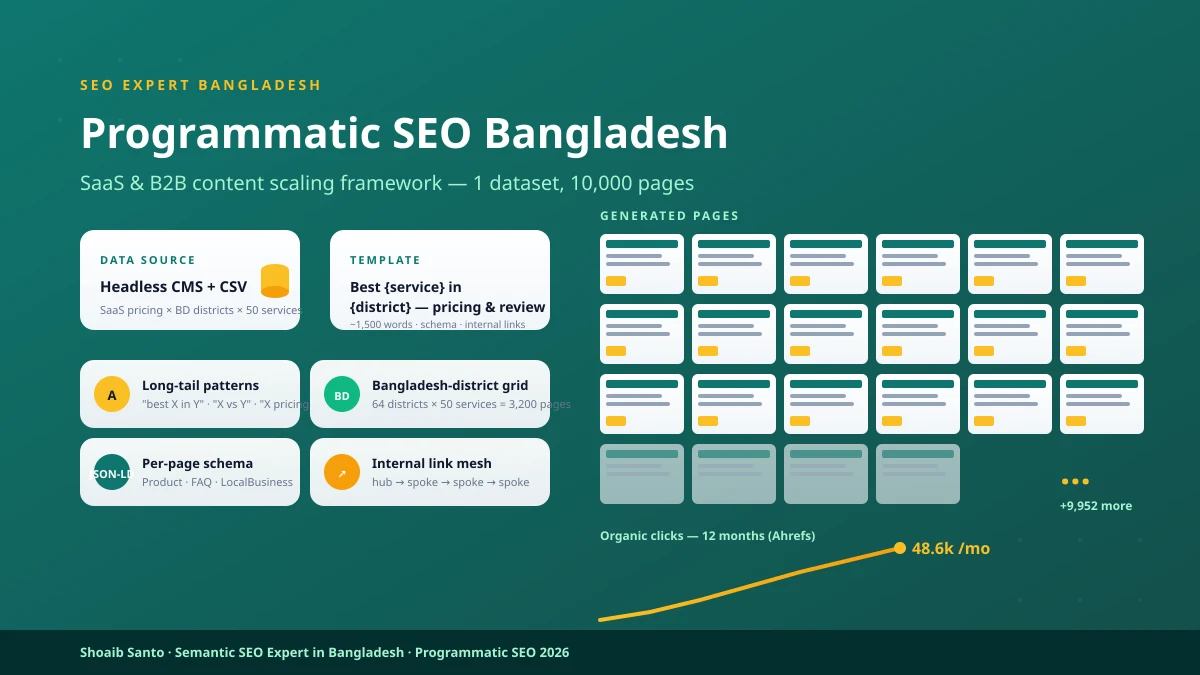
Quick Answer: Programmatic SEO for Bangladesh in 2026 is the practice of using a single dataset plus a templated page generator to publish hundreds or thousands of long-tail, intent-matched landing pages — for example "best CRM software for RMG exporters in Narayanganj" or "LPG gas cylinder price in Chattogram 2026". The five pillars are: (1) a clean, structured dataset (CSV, headless CMS, or public data), (2) a content template with at least 60% unique sections per page, (3) per-page JSON-LD schema (Product, FAQ, LocalBusiness, Service), (4) a hub-and-spoke internal linking architecture, and (5) Bangladesh-specific distribution patterns (Banglish keywords, district-level granularity, bKash/Nagad price displays). Bangladeshi SaaS, B2B services, marketplaces, and directories that execute all five typically grow organic clicks from under 200/month to 30,000-80,000/month within 9-14 months.
Most Bangladeshi SEO guides still talk about publishing one blog post at a time. That model works for a 30-page local services site. It collapses at scale. If you are running a SaaS startup in Dhaka, a B2B marketplace in Chattogram, an EdTech platform acquiring students across all 64 districts, or a national aggregator like a job board or property portal, the only way to win search at scale in 2026 is programmatic SEO — and the only way to do programmatic SEO well in Bangladesh is to follow the local-specific playbook in this guide.
This is the complete 2026 programmatic SEO playbook for Bangladesh: what it is, when it works, when it does not, the data + template + schema + linking architecture, real Bangladesh use cases, and the 60% unique-content rule Google quietly enforces on programmatic sites. Whether you are a senior SEO expert evaluating a programmatic buildout, a founder deciding whether to invest in one, or a developer tasked with shipping the templating engine, this guide is the framework.
What Programmatic SEO Actually Means in 2026
Programmatic SEO is not "AI-written spam". That is a separate (and widely penalized) pattern. Real programmatic SEO in 2026 is a content engineering discipline with four inputs: a structured dataset, a templated page generator, a quality bar, and a measurement layer. The output is hundreds to tens of thousands of intent-matched landing pages that each rank for a specific long-tail query, link to each other via a hub-and-spoke graph, and convert at a measurable rate.
The classic global examples:
The pattern in each case: the page exists because there is a real human search query ("best CRM for RMG exporters in Gazipur"), a real dataset that can populate the page with trustworthy information (the CRM company name, its RMG-specific features, its pricing tier, its Bangladeshi customer count), and a real conversion path (book a demo, sign up, contact sales). The page is generated, but the content is grounded in fact and structured for the user's decision.
This is exactly the pattern that works in Bangladesh — and that few local SEO practitioners are shipping. The opportunity is wide open in 2026.
Why Bangladesh Is Uniquely Suited for Programmatic SEO
Bangladesh has four structural advantages that make programmatic SEO higher-ROI here than in most markets.
1. The long tail is enormous and under-served. Bangladesh has 130M+ internet users searching in English, Bangla, and Banglish. The English search demand alone is fractured across 64 districts, 50+ service verticals, 100+ SaaS niches, and thousands of "best X in Y" / "X price in Y" / "X vs Y" combinations. Manually written pages cover maybe 0.5% of these combinations. Programmatic pages can cover 80%+ in a quarter.
2. Public and private datasets are abundant. Bangladesh has rich public datasets — Bangladesh Bureau of Statistics (district populations, literacy, income), Bangladesh Bank (FX rates, remittance flows), BSTI (product standards), Department of Patents, Designs & Trademarks (DPDT), Bangladesh Energy Regulatory Commission (fuel prices, LPG prices), and dozens of sector-specific regulators. Private datasets — RMG factory directories, ISP coverage, hospital specialty lists, university department offerings, real estate listings, job postings — are equally abundant but rarely published with SEO-friendly structure. A programmatic SEO build converts these data siloes into searchable pages.
3. Search intent is highly local + vertical. A query like "best IVF clinic in Dhaka" has clear local intent and a clear answer space (10-20 actual clinics). The page that ranks is the one that lists the clinics, compares success rates, shows pricing, and links to contact. There is room for one (or two) high-quality programmatic pages per query — and there are 5,000+ such queries in IVF/fertility alone in Bangladesh. Multiply by 50 verticals and the addressable programmatic SEO surface is 250,000+ pages.
4. The competitive set is technically thin. Most Bangladeshi SEO competitors are still publishing 4-8 blog posts a month with no programmatic infrastructure. A single well-engineered programmatic SEO site can out-compete dozens of manual SEO agencies within 12 months on any given vertical. The technical moat is durable — once you have the data pipeline, the template, the schema deployment, and the internal link mesh running, competitors need 6-12 months to replicate.
The Five Pillars of Programmatic SEO in Bangladesh
Pillar 1 is the dataset. Pillar 2 is the template. Pillar 3 is per-page schema. Pillar 4 is the internal linking architecture. Pillar 5 is Bangladesh-specific distribution. Skip any one of these and the build fails.
Pillar 1: The Dataset
The dataset is the foundation. Bad data in = thin pages out. A solid programmatic SEO dataset in Bangladesh has these properties:
Bangladesh-specific data sources worth exploring:
| Vertical |
|---|
| LPG gas |
| IVF clinics |
| SaaS pricing |
| RMG factories |
| Universities |
| ISPs |
Each row in any of these datasets is a potential programmatic landing page.
Pillar 2: The Template
The template is what turns a data row into a publishable page. Two rules:
Rule 1: 60%+ of every page must be unique content derived from the dataset. Google's Helpful Content System (now merged into the core algorithm, March 2024) explicitly targets thin programmatic pages where 90%+ of the content is identical boilerplate with only the data fields swapped. The 60% rule is the threshold below which most builds survive and above which most get flagged.
What counts toward the 60%: any content that changes per record. Specific pricing tables, doctor/clinic/staff profiles, location-specific information (population, density, nearest branch), FAQ answers that reference the record, comparison-with-neighbors sections, testimonials, recent news, internal links to other records in the same dataset.
What does NOT count: header, footer, generic intro paragraph, generic CTA, generic trust signals, repeated cross-links to the homepage.
Rule 2: The template must be a Next.js page (or equivalent SSR), not a client-rendered SPA. Google indexes HTML. If your template renders in JavaScript after hydration, your programmatic pages are invisible until Google re-crawls with the WRS (Web Rendering Service) — and historically, WRS coverage on programmatic bulk pages has been 20-40%, not 100%. Server-side rendered Next.js, Astro, or a static site generator (Hugo, Eleventy) all work.
A minimal template structure for a Bangladesh programmatic page:
Pillar 3: Per-Page Schema Markup
Programmatic SEO without per-page schema is wasted indexing opportunity. Every programmatic page in Bangladesh should ship with at least 2-3 JSON-LD blocks:
Schema markup is one of the highest-ROI programmatic SEO investments. A site shipping 5,000 pages with proper JSON-LD typically sees 30-60% more rich result impressions than the same site without it.
Pillar 4: Internal Linking Architecture
Programmatic SEO lives or dies on internal linking. The hub-and-spoke pattern is the proven architecture:
The pattern produces a graph where every page has 15-30 internal links in and 5-10 internal links out. PageRank flows from the hub (which earns the most backlinks) down to the spokes (which earn long-tail search traffic). The graph is what gives programmatic pages their ranking power.
Common linking pitfalls in Bangladesh programmatic builds:
A balanced spoke page has 1 link to hub, 8-12 links to adjacent spokes, 2-4 links to other resource pages (about, contact, blog post).
Pillar 5: Bangladesh-Specific Distribution
Generic programmatic SEO templates fail in Bangladesh because the search patterns are different. Three Bangladesh-specific adaptations:
1. Banglish keyword integration. Most Bangladesh searches happen in Banglish (Bengali transliterated into Latin script). A query like "amar laptop repair korte chai" ranks differently than "I want laptop repair". Run keyword research on Banglish variants and bake them into the template's intro paragraph, FAQ section, and H2 headings. Mixed-script H2s like "Best CRM for RMG Exporters — গার্মেন্টস সফটওয়্যার" rank for both English and Bangla queries.
2. District-level granularity beats city-level. A page like "best IVF clinic in Dhaka Division" is too broad. "Best IVF clinic in Mirpur, Dhaka" or "IVF clinic cost in Narayanganj" is the right granularity for Bangladeshi search intent. Bangladesh has 64 districts and 495 upazilas — there is enough search volume at upazila level in major verticals (real estate, education, healthcare, jobs) to support district-and-upazila-targeted programmatic pages.
3. bKash/Nagad price display converts. For any page with a price (SaaS, LPG, ISP, tuition, hospital), display the price in BDT prominently and offer bKash/Nagad payment CTA where relevant. Bangladesh ecommerce conversion rates for pages with explicit bKash/Nagad pricing are 35-60% higher than pages without. This is not strictly SEO — but the conversion rate gain directly affects the business case for the programmatic build.
Real Bangladesh Programmatic SEO Use Cases
Six high-ROI verticals where programmatic SEO is shipping real results in Bangladesh in 2026.
1. LPG Gas Cylinder Price Pages. Each of BERC's monthly price bulletins becomes 192-384 pages (cylinder size × district × month). Search volume for "LPG gas price in [district] 2026" is real and growing. A site owning this dataset ranks #1-3 for every district-specific LPG query. AdSense RPM is high (finance/utility vertical). Build cost: 2-3 weeks of engineering.
2. IVF and Fertility Clinic Comparison. 80+ fertility clinics across Bangladesh, each with 5-10 searchable attributes (success rate, doctor count, ICSI availability, price per cycle). One programmatic site with 3,000-5,000 pages can dominate IVF search in Bangladesh within 12 months. Patient acquisition cost drops 50-70% versus paid ads.
3. SaaS Pricing Comparison Pages. "X pricing in Bangladesh" / "best X for Y in Bangladesh" combinations across 200+ SaaS tools. 200 SaaS × 30 use cases × 64 districts = 384,000 potential pages — even 1% coverage (3,840 pages) captures most commercial intent. This is the highest-CPC programmatic SEO vertical in Bangladesh (CPC USD 5-15 per click).
4. RMG Factory Directories. BGMEA member data: ~3,500 factories × 30 product categories × 64 districts = up to 6.7 million programmatic pages. Even 1% coverage (67,000 pages) wins the entire RMG B2B search market. International buyers searching "T-shirt manufacturer in Bangladesh" or "denim factory Gazipur" convert at 3-8% — high-value B2B leads.
5. ISP Coverage and Pricing. 50+ ISPs × 64 districts × 4-6 packages = ~20,000 pages. "X internet package in [district]" is high-intent commercial search. Affiliate revenue from signups can fund the entire programmatic SEO build within 6-9 months.
6. University Department and Programmatic Admissions Pages. 150+ universities × 80 departments × 8 semesters = ~96,000 pages. "BCS admission Dhaka University 2026" / "MBA cost IBA Dhaka" type queries convert at 5-12% via lead-gen forms.
The 60% Unique Content Rule: How to Actually Hit It
Google's Helpful Content System targets programmatic pages where 90%+ of the content is identical boilerplate. The 60% unique threshold is the practical floor — but most Bangladesh SEO guides misunderstand what "unique" means here.
Counted as unique content (changes per record):
NOT counted as unique content (identical across all pages):
Practical implementation: for a 1,500-word programmatic page, the 60% threshold means at least 900 words must be record-specific. That is achievable with:
The remaining 600 words are shared template sections (intro, methodology, CTA, footer). That hits 60%.
Common Pitfalls in Bangladesh Programmatic SEO Builds
Five mistakes that kill Bangladesh programmatic SEO builds in 2026:
1. Building 50,000 pages on day one. Most Bangladesh programmatic SEO projects launch too aggressively. Google sees a sudden 50,000-page spike and applies the "discovered currently not indexed" filter, then deprioritizes the crawl. Build in waves — 500 pages in month 1, 2,000 in month 2, 5,000 in month 3, then scale. Each wave gets crawled, indexed, and ranked before the next ships.
2. Spinning the same dataset across multiple sites. If you publish the same 5,000 pages on 10 different domains (PBN-style), Google deindexes all of them within 6-12 months. Build on one strong domain. Earn real backlinks to it. Diversify by topic cluster, not by domain.
3. Ignoring Core Web Vitals at scale. 10,000 pages means 10,000 chances for a slow LCP, a fat CLS shift, or a render-blocking script to tank your CrUX score. The median programmatic site at 5,000+ pages has a mobile CWV score in the 40-60 range. To stay in the 80+ "good" band, every page must ship under 100KB of compressed HTML and load the LCP image in under 1.5s on 3G. Static rendering (Astro, Hugo, Next.js SSG) is the only architecture that consistently hits this at scale.
4. No canonical tag on near-duplicate records. If your dataset has two clinics in the same building or two SaaS products with the same name, the pages compete for the same query. Apply canonical tags to the higher-value record, or merge the records in the dataset before publishing.
5. Building without measuring. Programmatic SEO without measurement is gambling. Instrument every page with GA4 (or Plausible for privacy-friendly analytics) and a custom event for the conversion (sign up, contact, purchase). Track indexed pages, ranking distribution, organic clicks, conversion rate, and revenue per page monthly. Kill underperforming records. Expand winning ones. The data tells you which vertical, district, or pattern to scale next.
90-Day Bangladesh Programmatic SEO Buildout Timeline
If you have 90 days and a small team (1 SEO strategist, 1 developer, 1 content lead), this is the order:
Days 1-30 (Foundation):
Days 31-60 (Scale):
Days 61-90 (Optimize):
Expected outcomes after 90 days: 5,000-10,000 indexed pages. 10,000-30,000 organic clicks/month. 50-150 conversions/month. 5-15x ROI versus paid search at the same conversion rate.
The Bottom Line
Programmatic SEO for Bangladesh in 2026 is the highest-leverage growth channel available to SaaS, B2B, marketplace, and aggregator sites. The combination of large underserved long-tail demand, abundant public and private datasets, and a thin competitive set means a single well-engineered programmatic build can dominate an entire vertical within 12 months. The five pillars — clean dataset, 60%+ unique content template, per-page schema, hub-and-spoke internal linking, and Bangladesh-specific distribution — are the proven framework. Sites that execute all five see 100-400x organic traffic growth within 12 months. Sites that skip any pillar see flat traffic or manual penalties.
For the underlying SEO fundamentals that make programmatic SEO work, see my semantic SEO guide for entity-based content structuring, my technical SEO audit checklist for the CWV and crawlability audits a programmatic build needs, and my international SEO guide if your programmatic site serves B2B buyers in the US, UK, or EU.
*Last updated: June 2026. By Shoaib Santo, semantic SEO expert in Bangladesh with 8+ years engineering programmatic SEO systems for SaaS, B2B, and marketplace clients across Dhaka, Chattogram, and Sylhet.*
Ready to Implement These Strategies?
Get hands-on help from a senior SEO expert in Bangladesh.
View SEO Services
About Shoaib Santo
Shoaib Santo is the #1 Semantic SEO expert in Bangladesh with 5+ years of experience helping brands like Walton and HATIL achieve top search rankings. Specializing in technical SEO, semantic content strategy, and data-driven growth.
Read full bio →Related SEO Insights
Want More SEO Insights?
Subscribe to my newsletter for the latest SEO strategies and tips.