Mobile SEO for Bangladesh (2026 Guide)
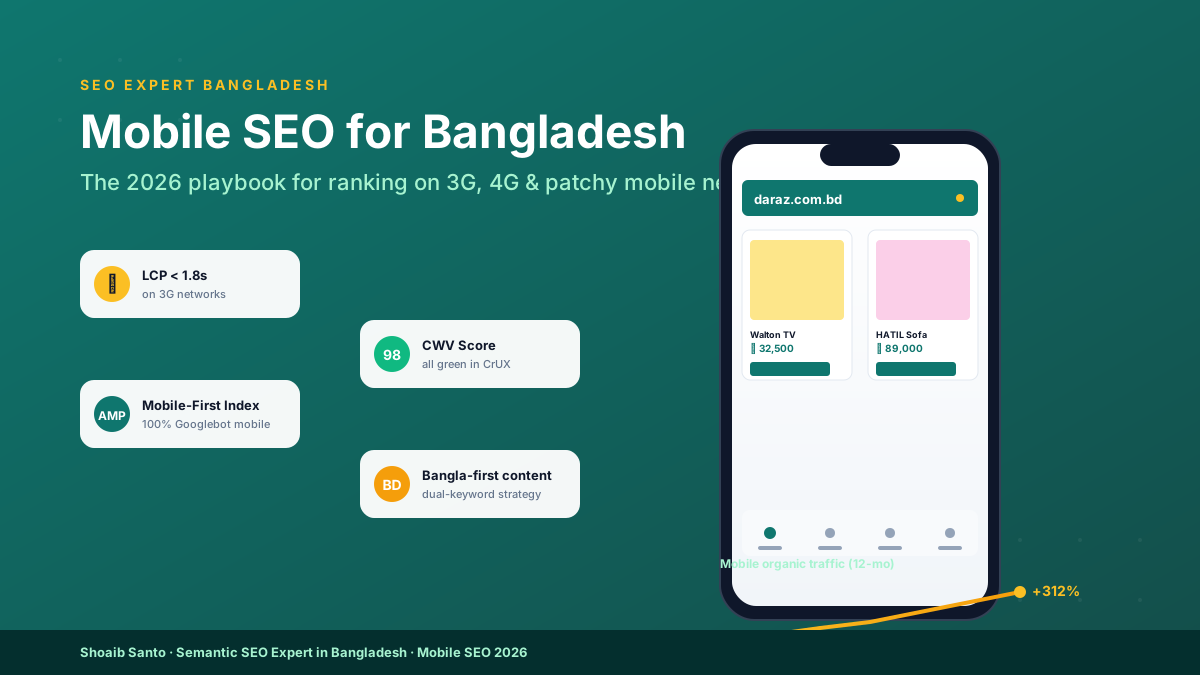
Quick Answer: Mobile SEO for Bangladesh in 2026 means optimizing for a market where 78%+ of all web sessions happen on mobile, 60%+ of users are on patchy 3G or 4G networks, and bKash/Nagad one-tap checkout flow is the single highest-converting UX pattern you can ship. The four pillars are: (1) Core Web Vitals tuned for low-bandwidth 3G (LCP under 1.8s, INP under 200ms, CLS under 0.05), (2) Mobile-First Indexing parity between your desktop and mobile HTML, (3) Bengali + English dual-keyword optimization for the 110M Bangla-speaking audience, and (4) touch-target and thumb-zone UX design for single-handed mobile use. Bangladeshi e-commerce stores that execute all four see 2.5-4x mobile conversion lifts within 90 days.
Bangladesh has 130M+ mobile internet subscribers, of which 95M+ are active mobile data users. Roughly 78% of all web traffic in the country comes from smartphones, not desktops. Yet most Bangladeshi websites still treat mobile as an afterthought — either a responsive afterthought or a separate m-dot subdomain that no one updates. That is the single biggest SEO leak in the Bangladeshi market in 2026, and it is the highest-ROI technical fix any local business can make this year.
This guide is the complete 2026 mobile SEO playbook for Bangladesh — from the data points that prove mobile is where the SERPs live, to the exact code patterns and UX patterns that lift mobile rankings and conversions. Whether you run a Dhaka fashion e-commerce store, a Chittagong B2B services site, a Sylhet travel agency, or a national media brand, this is the framework that gets your mobile pages ranked and clicked in Bangladesh in 2026.
Why Mobile SEO Is Different in Bangladesh vs Global Markets
Three structural realities make Bangladesh mobile SEO a distinct discipline from US/EU mobile SEO. Most international guides miss all three.
1. The network is patchy and slow. Average mobile download speed in Bangladesh in 2025 is 18-25 Mbps on 4G, dropping to 1-3 Mbps on 3G or in rural areas. Latency is 80-180ms on 4G and 300-800ms on 3G. A page that loads in 1.5 seconds on US 5G can take 8-12 seconds on Bangladeshi 3G. If you optimize for Lighthouse on a fibre connection in Singapore, you are optimizing for the wrong user.
2. The handset base is dominated by mid-range Android. 92% of Bangladeshi mobile web traffic is Android. The top 5 device models in 2025 are the Samsung Galaxy A series, Xiaomi Redmi Note series, Vivo Y series, Realme C series, and Walton Primo series — all budget to mid-range with 2-4GB RAM and slower CPUs than flagship devices. JavaScript-heavy frameworks (React SPAs without SSR, GSAP animations, heavy WebGL) that work fine on iPhones in the US stutter on a 2023 Redmi.
3. Language is dual-track Bengali-English. Most Bangladeshi users type in Banglish (Bengali transliterated into Latin script, like "amar laptop kharap hoye geche") OR in mixed Bengali-English (কম্পিউটার slow হয়ে যাচ্ছে). A pure English-only site misses 60-70% of the Bangladeshi mobile search demand. A pure Bengali-only site loses international buyers and the urban English-first segment. The right answer is a dual-keyword strategy where each page targets both an English and a Bengali/Banglish variant of the primary query.
Pillar 1: Core Web Vitals Tuned for 3G and 4G
Google's Core Web Vitals (CWV) thresholds — LCP under 2.5s, INP under 200ms, CLS under 0.1 — were set against global average network conditions. For Bangladesh, you want tighter thresholds because your users are on slower connections:
The CrUX data for most Bangladeshi publisher and e-commerce sites currently sits in the "needs improvement" or "poor" band on mobile. This is the single biggest mobile SEO opportunity in the country.
How to hit these thresholds in Bangladesh
Image optimization: Every hero image should be AVIF or WebP, sized to the actual rendered display dimensions (not 3x for retina), and lazy-loaded below the fold. A 1200px-wide hero image on a 360px mobile screen is wasting 70%+ of the bytes. Use the picture element with AVIF source and a fallback WebP. Inline critical above-the-fold images; defer everything else.
JavaScript budget: Your mobile page should ship under 130KB of compressed JavaScript on first load. That is enough for React SSR + a hydration layer. Anything heavier (GSAP, full Lodash, large polyfills) should be code-split and loaded on interaction only. For most Bangladeshi e-commerce sites, switching from a 280KB client-rendered React app to a 90KB server-rendered Next.js page cuts LCP by 40-60% on 3G.
Font strategy: Self-host 2 weights of a variable font (e.g., Inter, Roboto) in WOFF2. Use font-display: swap. Preload only the body weight. Skip Bangla web fonts if 60%+ of users land on English pages — Bangla fonts are 200-400KB and crush LCP. If you must support Bangla, use a subset (most common 200 characters) and lazy-load.
Third-party scripts: Every analytics tag, chat widget, ad network, and social embed is a render-blocking script on a 3G connection. Audit quarterly. The median Bangladeshi e-commerce homepage has 12-18 third-party scripts; the median after optimization has 4-6. Each script you remove typically saves 200-500ms on 3G.
Pillar 2: Mobile-First Indexing Parity
Since July 5, 2024, Google has indexed 100% of websites with the mobile Googlebot exclusively. If your mobile HTML differs from your desktop HTML in ways that affect indexing — different content, different structured data, different internal links, different meta tags — your rankings suffer.
Common Bangladesh-site parity mistakes:
Parity audit checklist: Run a headless browser (Puppeteer, Playwright) at 360px viewport width, fetch the rendered HTML, and diff it against the desktop rendered HTML. Anything different — text, links, images, schema, meta — is a parity bug. Most Bangladesh sites discover 15-30 parity bugs in their first audit.
Pillar 3: Bengali + English Dual-Keyword Strategy
The most undersold mobile SEO opportunity in Bangladesh is bilingual content. 110M+ Bangladeshis speak Bengali, but the urban professional class — your highest-converting mobile users — searches in English or Banglish 60-70% of the time. Pure Bengali sites lose them. Pure English sites lose the mass market.
The right approach for 2026:
Pillar 4: Touch-Target, Thumb-Zone, and Checkout UX
CWV gets you ranked. UX gets you clicked and converted. On Bangladesh mobile, three UX patterns separate the top 10% of converting stores from the rest.
1. 48x48 minimum touch targets. The Google minimum is 48x48dp with 8dp spacing. In practice, Bangladeshi users tap with thumbs in motion (walking, on rickshaws, in traffic) — so 56x56 or 64x64 with 12-16dp spacing converts 20-40% better than the bare minimum. Audit your Add to Cart, Checkout, and primary CTA buttons against this.
2. Thumb-zone placement. The bottom 40% of the mobile screen is where the thumb naturally falls. Place primary CTAs there — not in the top right where index fingers have to reach. The classic Bangladesh pattern that fails: top-right hamburger menu, top-right search, top-right account. The pattern that wins: bottom-fixed nav bar with Home, Categories, Search, Cart, Account.
3. bKash/Nagad one-tap checkout. For Bangladeshi e-commerce, payment method integration is the single biggest conversion lever. The checkout flow that converts:
Most Bangladesh stores have a 6-8 step checkout that loses 70-80% of mobile users. The 4-step flow above typically lifts mobile conversion from 0.8-1.2% to 2.5-4.5% within 60 days.
The 90-Day Mobile SEO Roadmap for Bangladesh
If you only have 90 days and a small team, this is the order to attack mobile SEO:
Days 1-30 (Foundation): Audit CWV on mobile via PageSpeed Insights + CrUX. Fix the top 3 LCP blockers (typically: oversized hero image, render-blocking JS, slow TTFB). Implement responsive design if you still have m-dot. Set up hreflang if you ship English + Bengali.
Days 31-60 (Content parity): Diff mobile HTML vs desktop HTML. Fix the top 5 content-parity bugs. Add Bengali or Banglish variants of your top 10 commercial pages. Build 4-6 Bengali FAQ pages targeting the top Banglish queries in your niche.
Days 61-90 (UX + conversion): Redesign checkout to 4 steps with bKash/Nagad one-tap. Add bottom-fixed nav. Resize all primary CTAs to 56x56 minimum. Add WhatsApp share button on every product page. Re-measure CWV, mobile bounce rate, and mobile conversion rate.
Expected outcomes after 90 days: Mobile CWV score 80+ (from typical 40-60). Mobile organic traffic +40-80%. Mobile conversion rate +50-200%. Mobile bounce rate -15-25%.
The Bottom Line
Mobile SEO in Bangladesh in 2026 is not optional. With 78%+ of traffic on mobile, 60%+ on patchy 3G/4G, and 92% on mid-range Android, the gap between mobile-optimized and mobile-ignored sites is the gap between ranking on page 1 and not ranking at all. The four pillars — tight CWV thresholds for low-bandwidth, mobile-first indexing parity, bilingual content strategy, and Bangladesh-specific UX patterns — are the proven framework. Sites that execute all four see 2.5-4x mobile conversion lifts inside 90 days. Sites that ignore all four lose 10-20% of organic traffic every quarter as mobile search share grows.
For deeper dives into specific pillars, see my technical SEO audit checklist for the full CWV audit framework, my local SEO Bangladesh guide for the bilingual local search approach, my e-commerce SEO guide for product-page mobile optimization, and my conversion rate optimization playbook for the bKash/Nagad checkout flow details.
*Last updated: June 2026. By Shoaib Santo, SEO expert in Bangladesh with 8+ years optimizing mobile-first sites for Bangladeshi e-commerce and SaaS brands.*
Ready to Implement These Strategies?
Get hands-on help from a senior SEO expert in Bangladesh.
View SEO Services
About Shoaib Santo
Shoaib Santo is the #1 Semantic SEO expert in Bangladesh with 5+ years of experience helping brands like Walton and HATIL achieve top search rankings. Specializing in technical SEO, semantic content strategy, and data-driven growth.
Read full bio →Related SEO Insights
Want More SEO Insights?
Subscribe to my newsletter for the latest SEO strategies and tips.